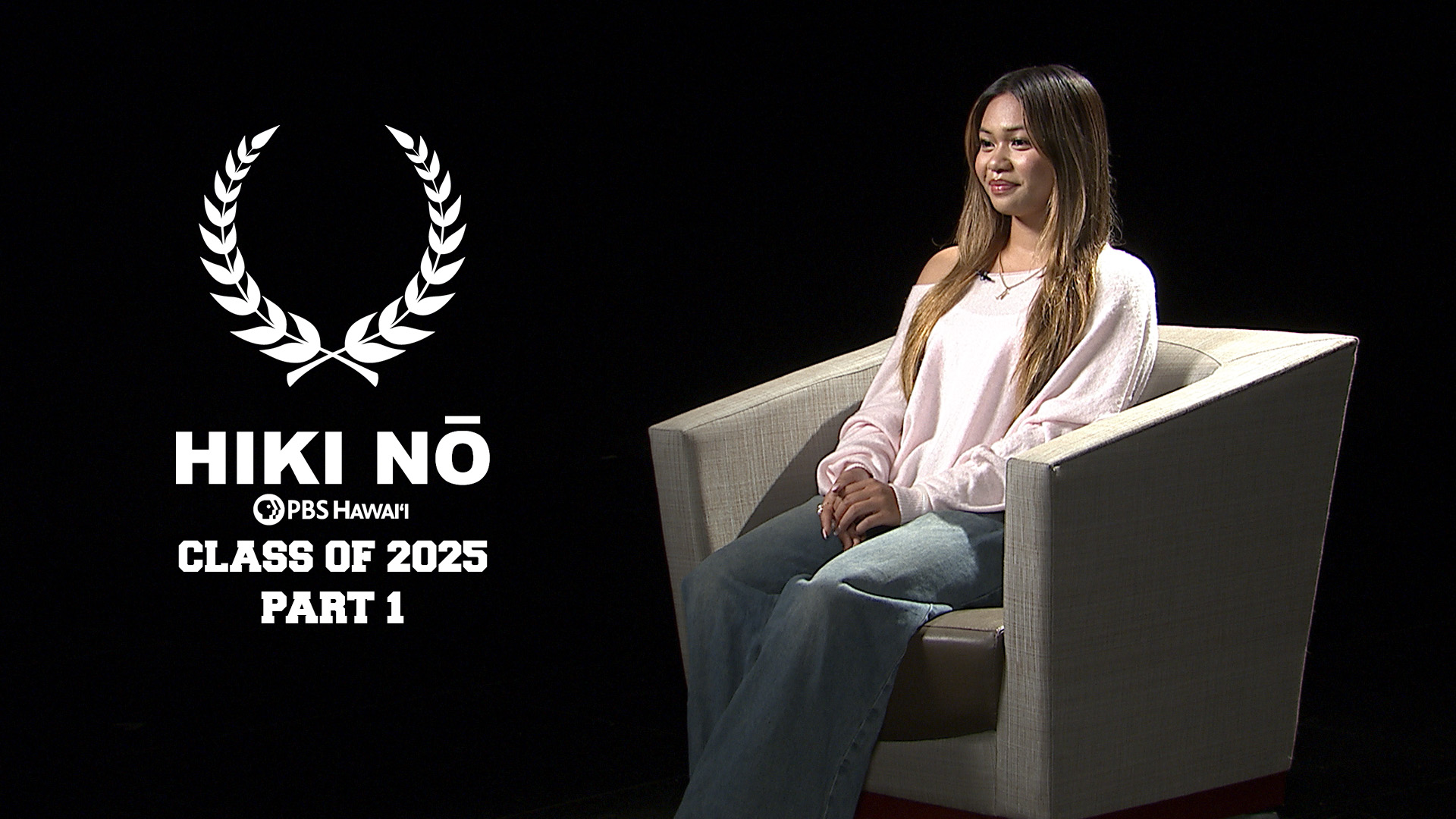
In this episode of HIKI NŌ on PBS Hawai‘i, the first of two special episodes, meet four stellar graduates from HIKI NŌ’s Class of 2025 and witness their journeys to become star storytellers on HIKI NŌ on PBS Hawaiʻi.
Wai’anae High School graduate Natasha Maʻafala recounts how her interest in media began from a young age, but entering Searider Productions during high school was life changing.
“It just seemed really intense, everyone was doing something, everyone in the class looked like they knew what they were doing,” she says. “Everyone had purpose and they were moving with purpose. John (Allen III) would put a task out there and theyʻd get straight to it no questions asked. So as a freshman, that really scared me.”
Nevertheless, she stuck with it, and learned from her production mistakes along the way. Ultimately, she and her classmates took home several story awards from HIKI NŌ on PBS Hawaiʻi Challenges throughout her high school career.
Maʻafala will attend University of Hawaiʻi at Mānoa on Oʻahu to study journalism and communications.
“Having that mentality of producing my best work no matter the situation, I think thatʻs going to serve me not only after high school but in life in general,” she says.
Raphael Stark, a homeschool graduate from Oʻahu, also shares his experience with HIKI NŌ on PBS Hawaiʻi. Stark — who is also the founder of Caring for Hawaii Teens with Speech Challenges (CHATS) — discusses his love for visual media, and working as a one-person production team to produce two stories for PBS Hawaiʻi.
“All of the skills I have had to use and have had to learn, I think that really prepares you for what you’re going to face,” he says.
Stark will attend the Savannah College of Art and Design to study film and television.
Waiākea High School graduates Moriah Amuimuia and Kama Paulo-Galsote discuss the joys of producing work for HIKI NŌ on PBS Hawaiʻi, whether it be for Challenge competitions or feature stories. They enjoyed finding their distinctive roles on production teams and publishing their work after hours of dedication.
“Everything we did – retakes, editing, shooting, long hours we worked… It was just like, so rewarding. It felt worth it,” Amuimuia says.
Paulo-Galsote entered the video production class at Waiākea as a sophomore.
“I was one of the laziest kids in the class,” he recalls. “But after doing some stuff I realized it was kind of what I did at Keaukaha (Elementary School). That was the turning point for me. Seeing a bunch of likeminded people working, like it’s a big unit, everyone is moving with a purpose and playing their part and their role.”
Now, Paulo-Galsote is considering becoming a teacher himself and will study media and education at University of Hawaiʻi at Hilo, while Amuimuia will attend Hawaiʻi Community College.
==
HIKI NŌ 10|7|25: 1621